EVIDENCE STUDIES · NO. 002 · 2026-11-06
Ten pollsters registered 56% of the 1,404 presidential polls of 2026.
Every published election poll must be registered with the TSE first. In 2026, 141 pollsters registered at least one presidential poll, and 33% of them ended fieldwork in September. The registry shows who, when, how and with how many interviews; it has no result by candidate.
The numbers
- 56%
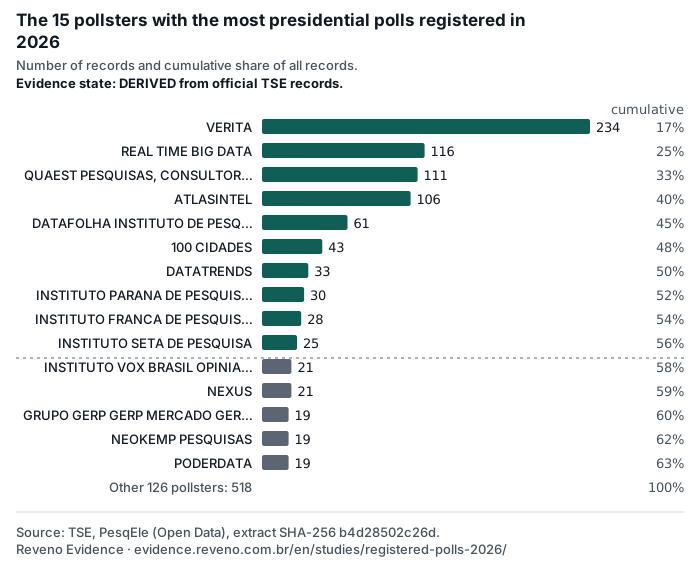
of registered polls came from the 10 pollsters with the most records. 141 pollsters registered at least one; 35 registered only one.
Derived See Fig. 2
- 468
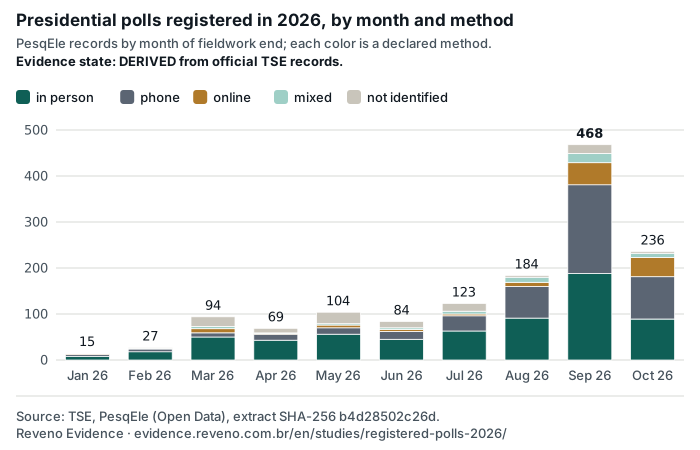
polls ended fieldwork in September 2026, 33% of the year. In October, the month of both rounds, there were 236.
Derived See Fig. 1
- 46%
of records declare in-person interviews; 32% by phone and 9% online. In 116, the text does not allow a classification.
Derived See Fig. 1
- 24%
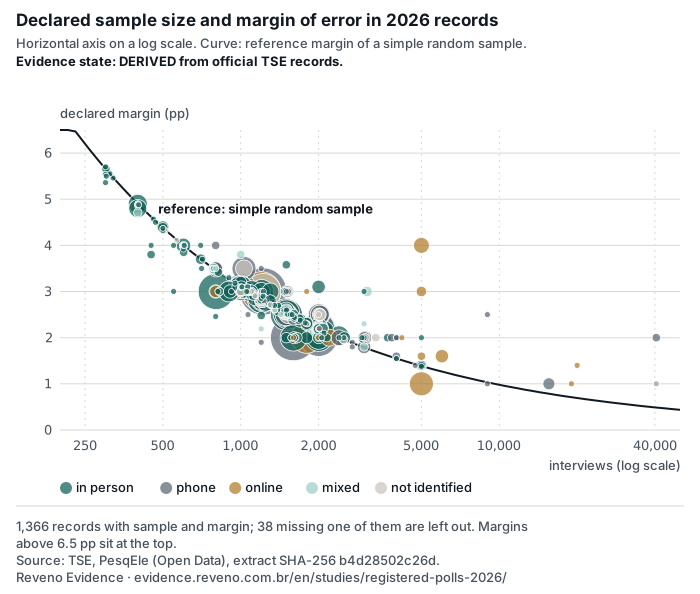
of the 1,366 records with sample and margin declare a margin smaller than that of a simple random sample of the same size. This is what the record declares; the sample design may explain the difference.
Derived See Fig. 3
1. When and how
Polls by month of fieldwork end, stacked by declared method. The method is classified by keywords in the text the pollster registered.
See the table
| Month | Total | In person | Phone | Online | Mixed | Not identified |
|---|---|---|---|---|---|---|
| Jan 26 | 15 | 8 | 4 | 2 | 0 | 1 |
| Feb 26 | 27 | 18 | 6 | 1 | 1 | 1 |
| Mar 26 | 94 | 50 | 9 | 9 | 5 | 21 |
| Apr 26 | 69 | 43 | 13 | 2 | 1 | 10 |
| May 26 | 104 | 56 | 14 | 6 | 3 | 25 |
| Jun 26 | 84 | 45 | 17 | 4 | 4 | 14 |
| Jul 26 | 123 | 63 | 33 | 4 | 6 | 17 |
| Aug 26 | 184 | 91 | 69 | 9 | 11 | 4 |
| Sep 26 | 468 | 188 | 193 | 48 | 20 | 19 |
| Oct 26 | 236 | 89 | 92 | 42 | 9 | 4 |
2. Who registered
The 15 pollsters with the most records, from most to least, and the cumulative share of the total. Teal bars: the top ten.
See the table
| Pollster | Records | % of total | Cumulative |
|---|---|---|---|
| VERITA | 234 | 16.7% | 16.7% |
| REAL TIME BIG DATA | 116 | 8.3% | 24.9% |
| QUAEST PESQUISAS, CONSULTORIA E PROJETOS | 111 | 7.9% | 32.8% |
| ATLASINTEL | 106 | 7.5% | 40.4% |
| DATAFOLHA INSTITUTO DE PESQUISAS | 61 | 4.3% | 44.7% |
| 100 CIDADES | 43 | 3.1% | 47.8% |
| DATATRENDS | 33 | 2.4% | 50.1% |
| INSTITUTO PARANA DE PESQUISAS E ANALISE DE CONSUMIDOR | 30 | 2.1% | 52.3% |
| INSTITUTO FRANCA DE PESQUISA PESQUISA E ASSESSORIA | 28 | 2.0% | 54.3% |
| INSTITUTO SETA DE PESQUISA | 25 | 1.8% | 56.1% |
| INSTITUTO VOX BRASIL OPINIAO E PESQUISAS | 21 | 1.5% | 57.5% |
| NEXUS | 21 | 1.5% | 59.0% |
| GRUPO GERP GERP MERCADO GERP OPINIAO GERPAUDIT | 19 | 1.4% | 60.4% |
| NEOKEMP PESQUISAS | 19 | 1.4% | 61.8% |
| PODERDATA | 19 | 1.4% | 63.1% |
3. Declared sample and margin
Each circle is a group of records with the same sample, margin and method; the area is the number of records. The curve is the margin of a simple random sample of the same size (95% confidence, p = 0.5). Below the curve, the declared margin is smaller than that reference.
See the table
| Method | Records with sample and margin | Below the reference | % |
|---|---|---|---|
| in person | 629 | 170 | 27% |
| phone | 445 | 100 | 22% |
| online | 126 | 49 | 39% |
| mixed | 51 | 3 | 6% |
| not identified | 115 | 0 | 0% |
Method and limits
Records come from PesqEle in TSE Open Data (president, 2026), read without changing values, with SHA-256 checked at publication. Names of statisticians and individual contractors are left out. Method class and margin are derived from the registered text, with the rules on the election polls page.
top10_share = records of the 10 pollsters with the most records / total records
reference_margin(n) = 100 × 1.96 × √(0.25 / n)
below_reference = declared_margin < reference_margin(sample) − 0.1
What the data does not allow us to say
- A record is not a result: PesqEle has no estimate by candidate, so accuracy cannot be measured.
- Registering does not mean publishing; the month is the declared end of fieldwork.
- A margin below the reference is not an error or fraud: stratification and weighting change the math, and the record does not include the design effect. For non-probability samples, the margin does not have the same meaning.
- The method class comes from keywords in the pollster text and may be wrong for ambiguous texts.
- The study does not rank pollsters by quality; the order in Fig. 2 is only the number of records.
Authorship and review
Written by Thiago Holtz for Reveno Evidence and published on November 6, 2026. Internal review; no independent review yet. Corrections are added here, dated, without deleting the previous version.
History
- Version 1, November 6, 2026: publication.
About this data
- What it measures
- Presidential poll records in 2026: pollster, month of fieldwork end, declared method, sample and margin, and the comparison of the margin with the simple random sample reference.
- Source
- Brazil's Superior Electoral Court (TSE), PesqEle in Open Data, in the collection manifest.
- Unit
- Records (count); share of the total; interviews; percentage points (pp).
- Period
- Fieldwork ending from January 2026 to October 2026.
- Last collected
- Next scheduled collection
- Not applicable: dated edition, with records made up to 2026-11-03. If the TSE changes one of those records, the page says so and recalculates.
- Maintained by
- Thiago Holtz, Reveno Evidence
- Evidence state
- Observed Derived
- Version
- Extract SHA-256
b4d28502c26de600 - License
- Text, figures and calculations of this study: CC BY 4.0, with attribution to Reveno Evidence and a link to this page. Source data: Brazil's Superior Electoral Court (TSE), public data, under the court's terms.
Download the data
What is on screen
The tables on this page as CSV, with unformatted numbers and the evidence state of every row.
The full set, with a manifest
A ZIP with every file behind the page, a README with the citation and license, and a manifest with the SHA-256 of each file.
For machines
A JSON at a stable address, with metadata, citation, tables and sources. The address does not change between publications; the content changes when the collection changes.
- dados.json
https://evidence.reveno.com.br/estudos/pesquisas-registradas-2026/dados.json
- dados.json
How to cite
Short citation for a chart or table caption, or a note
TSE (2026), processed by Reveno Evidence
Full citation with URL and access date
Reveno Evidence (2026). Ten pollsters registered 56% of the 1,404 presidential polls of 2026 [Data set]. Evidence Studies no. 002, by Thiago Holtz. Source data: Brazil's Superior Electoral Court (TSE), PesqEle, Open Data. Extract SHA-256 b4d28502c26de600. Retrieved November 6, 2026, from https://evidence.reveno.com.br/en/studies/registered-polls-2026/
BibTeX
@misc{reveno_evidence_estudo_002,
  author = {{Reveno Evidence}},
  title = {Ten pollsters registered 56% of the 1,404 presidential polls of 2026},
  year = {2026},
  publisher = {Reveno},
  url = {https://evidence.reveno.com.br/en/studies/registered-polls-2026/},
  urldate = {2026-11-06},
  note = {Evidence Studies no. 002, by Thiago Holtz. Source data: Brazil's Superior Electoral Court (TSE), PesqEle, Open Data. Extract SHA-256 b4d28502c26de600}
}
The access date is filled in with the date of this version of the page; replace it with the date you accessed it.
When you use a number, also cite the source file: id, URL and SHA-256 are in the sources table.
Text, figures and calculations of this study: CC BY 4.0, with attribution to Reveno Evidence and a link to this page. Source data: Brazil's Superior Electoral Court (TSE), public data, under the court's terms.